Reduce Activities, continued
REPSA - Life Cycle Analysis of Expanded Polystyrene

 The
eleven manufacturers and five raw material suppliers that make up REPSA
are signatories to the Expanded Polystyrene (EPS) Industry Group Action
Plan. This is an agreement between government and industries involved
in producing, using and disposing of EPS boxes. The
eleven manufacturers and five raw material suppliers that make up REPSA
are signatories to the Expanded Polystyrene (EPS) Industry Group Action
Plan. This is an agreement between government and industries involved
in producing, using and disposing of EPS boxes.
It is based on shared environmental responsibility for all aspects of
the life-cycle of EPS boxes - from raw material suppliers to retailers
and final disposal.
 The
Plan includes action to improve the efficiency and sustainability of kerbside
recycling operations around Australia. EPS for recycling is compressed
to remove the air and then melted and converted to a general-purpose polystyrene
(GPPS). This is used to manufacture a variety of products, including videocassettes,
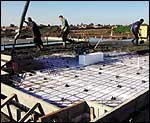
coat hangers and synthetic timber. EPS products can also be granulated
and incorporated into other products such as lightweight concrete and
waffle pods used extensively in the building trade. The
Plan includes action to improve the efficiency and sustainability of kerbside
recycling operations around Australia. EPS for recycling is compressed
to remove the air and then melted and converted to a general-purpose polystyrene
(GPPS). This is used to manufacture a variety of products, including videocassettes,
coat hangers and synthetic timber. EPS products can also be granulated
and incorporated into other products such as lightweight concrete and
waffle pods used extensively in the building trade.
Life-cycle analysis confirms that the environmental impact of EPS boxes
is less than other products performing the same task:
- EPS generates less greenhouse emissions over its life-cycle than other
packaging materials.
- EPS is CFC free and is produced from a by-product of the petroleum
industry;
- EPS is 98% air - so it weighs less, requires less energy to produce
and requires less energy for transportation.
- EPA also has superior insulation properties, so it can keep products
fresh at the correct temperature for longer and is also moisture resistant
and shock resistant.
|